
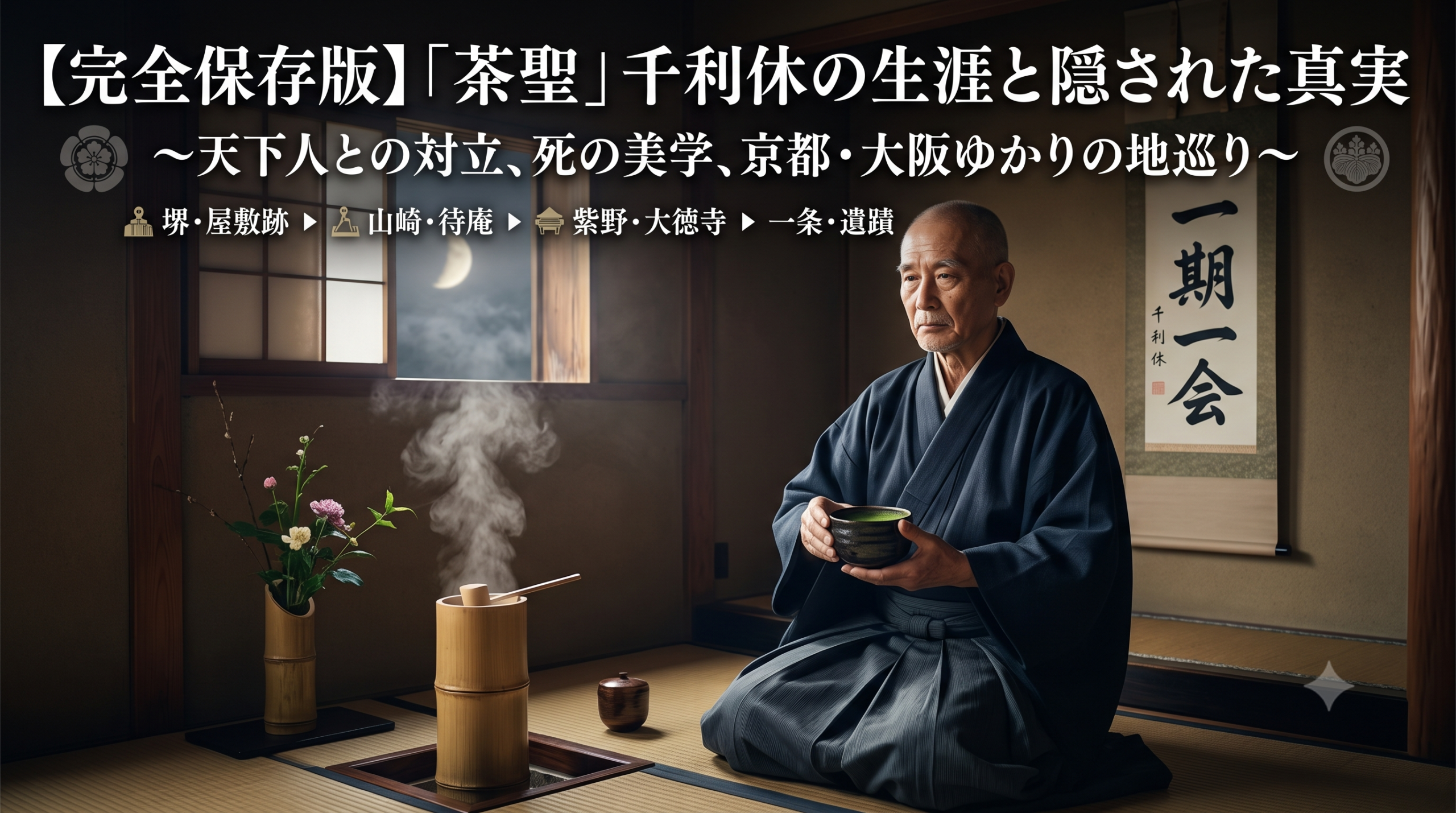
Sen no Rikyu, revered as the “Chasei” (Tea Saint), perfected “Wabi-cha”—a quintessential Japanese aesthetic centered on simplicity, rustic beauty, and spiritual mindfulness.
Serving two of Japan’s most powerful warlords, Oda Nobunaga and Toyotomi Hideyoshi, Rikyu transcended the role of a mere tea master, wielding immense influence at the center of national politics. Yet at the height of his prominence, Hideyoshi abruptly ordered him to commit seppuku (ritual suicide), ending his 70-year life.
How did a humble merchant rise to become the supreme arbiter of Japanese culture?
And why did an irreconcilable clash between political power and artistic aesthetic demand his death?
This guide explores the dramatic twists of Rikyu’s life alongside the historic sites in Kyoto, Osaka, and Sakai that preserve his revolutionary spirit today.
- 🚶♂️ Overview: Walking in the Footsteps of Sen no Rikyu
- 1. [Sakai] Rising from Rock Bottom: Meeting the Way of Tea
- 2. [Yamazaki] Serving Hegemons and Perfecting “Wabi-cha”
- 3. [Daitoku-ji] The Fatal Kinmokaku Gate and the Rift with Hideyoshi
- 4. [Ichijo] The Final Moment: Legacy of “One Encounter, One Opportunity”
- 📚 Recommended Books for Exploring Kyoto & Sengoku History
- 💡 Notes & Disclaimer
- 🎥 Referenced Videos
🚶♂️ Overview: Walking in the Footsteps of Sen no Rikyu
- [Sakai] Sen no Rikyu House Site & Sakai Plaza of Rikyu and Akiko: Rikyu’s merchant beginnings and roots.
2. [Yamazaki] National Treasure Tai-an (Myoki-an): The ultimate expression of Wabi-cha within a microscopic two-tatami space.
3. [Kyoto / Murasakino] Daitoku-ji Temple (Kinmokaku Gate): The fatal gatehouse that provoked Hideyoshi’s fury.
4. [Kyoto / Ichijo] Monument to Sen no Rikyu (Near Seimei Shrine): The site of his final residence where he met his end.
1. [Sakai] Rising from Rock Bottom: Meeting the Way of Tea
Rikyu’s story began in Sakai (modern-day Sakai City, Osaka), Japan’s wealthiest autonomous merchant port of the Sengoku period.
📜 History & Lore: From Fish Merchant’s Heir to Cultural Master
Born in 1522 as Tanaka Yoshiro, the eldest son of a prosperous fish wholesaler, Rikyu began studying tea in his mid-teens as an essential gentlemanly accomplishment. Tragedy struck in his late teens when both his father and grandfather passed away in close succession, leaving the family business in financial distress. At his lowest point, he reportedly could not even afford a proper memorial service for his grandfather.
Undeterred, Rikyu committed himself to the art of tea under Takeno Joo, a renowned Sakai tea master. As he honed his aesthetic sensibilities, he also demonstrated remarkable commercial acumen, eventually serving as a purveyor to regional warlords like the Miyoshi clan and regaining his family’s prosperity.
- Must-Visit Spot: Sen no Rikyu House Site (Camellia Well) & Sakai Plaza of Rikyu and Akiko
- The original estate grounds still preserve the “Camellia Well” (Tsubaki no Ido), whose water was favored for tea. Nearby, the Sakai Plaza of Rikyu and Akiko showcases exhibits, replicas of his tearooms, and authentic tea tastings.
2. [Yamazaki] Serving Hegemons and Perfecting “Wabi-cha”
When Oda Nobunaga brought Sakai under direct military control, Rikyu was appointed as one of his official tea masters (sado). Following Nobunaga’s assassination in the Honno-ji Incident of 1582, Rikyu entered the service of Toyotomi Hideyoshi.
📜 History & Lore: Philosophy Behind the Two-Tatami “Tai-an”
Contemporary accounts noted that “matters of state belong to Hidenaga (Hideyoshi’s half-brother), while intimate matters belong to Rikyu,” illustrating his extraordinary standing in the regime. Even as he designed an extravagant “Golden Tea Room” to satisfy Hideyoshi’s lust for grandeur, Rikyu independently cultivated his signature counter-aesthetic: Wabi-cha.
The pinnacle of this philosophy survives at Yamazaki, near the border of Kyoto and Osaka.
“A Radical Space of Just Two Tatami Mats”
Rejecting lavish Chinese imports (karamono), Rikyu embraced earthen walls, subtle natural light, and hand-formed, unadorned Japanese Raku teaware crafted with tile maker Chojiro. Stripping away all ostentation, he transformed tea into an intimate ritual where host and guest shared a singular, unrepeatable moment (Ichigo Ichie—”one encounter, one lifetime”).
- Must-Visit Spot: National Treasure Tai-an (Myoki-an Temple)
- The only surviving tearoom confirmed to have been built directly by Rikyu. Its two-tatami layout encapsulates the absolute essence of Zen minimalism. (Advance reservation required)
3. [Daitoku-ji] The Fatal Kinmokaku Gate and the Rift with Hideyoshi
In early 1591, at the zenith of his influence, Rikyu was suddenly banished from Kyoto and commanded by Hideyoshi to end his own life.
📜 History & Lore: Why Did the Supreme Tea Master Have to Die?
The conventional trigger was the main gate (Kinmokaku) of Daitoku-ji Temple.
Rikyu had financed the construction of the gate’s upper story, where the monks installed a wooden statue of Rikyu wearing straw sandals. When Hideyoshi learned of this, he took it as an intolerable insult, furious that he—the ruler of Japan—was forced to walk beneath the feet of a common merchant.
Yet historians recognize deeper, systemic tensions:
- Political & Economic Clout: Through his appraisals of tea treasures, Rikyu commanded vast wealth and commanded the loyal devotion of influential samurai lords.
- Aesthetic Conflict: Hideyoshi’s authoritarian taste for opulence stood fundamentally at odds with Rikyu’s austere, uncompromising minimalism.
- Foreign Policy Disagreement: Rikyu reportedly voiced opposition to Hideyoshi’s impending invasions of the Asian mainland (the Imjin War).
When supreme political power met supreme cultural authority, neither side bowed. Refusing to compromise his artistic integrity, Rikyu accepted death.
- Must-Visit Spot: Daitoku-ji Temple (Kinmokaku Gate & Juko-in)
- The temple complex remains deeply associated with Rikyu and the three Sen families (San-Senke), preserving ancient wells, historic tearooms, and the graves of tea masters.
4. [Ichijo] The Final Moment: Legacy of “One Encounter, One Opportunity”
Confronting his death sentence, Rikyu returned to his Kyoto residence within Hideyoshi’s Jurakudai mansion complex and waited in silence.
📜 History & Lore: A Final Bowl of Tea as the Kettle Sings
On April 21, 1591 (the 28th day of the 2nd lunar month), when the executioners arrived, Rikyu reportedly greeted them calmly, saying, “The tea is ready in the tearoom.” After serving his guests one last bowl, he calmly performed seppuku while listening to the soothing hiss of boiling water in the iron kettle.
Although his residence was demolished, his spirit endured. Disciple lords such as Maeda Toshiie and Hosokawa Tadaoki, along with his descendants who founded the Omotesenke, Urasenke, and Mushakojisenke schools, ensured that his philosophy of mindfulness and hospitality would shape Japanese culture for centuries to come.
- Must-Visit Spot: Monument to Sen no Rikyu (Near Seimei Shrine)
- Located along Horikawa Street near Seimei Shrine, this stone marker and the historic “Rikyu Well” commemorate the grounds of his final Kyoto estate.
📚 Recommended Books for Exploring Kyoto & Sengoku History
For travelers eager to discover the deeper, mystifying layers of Kyoto and the architectural heritage of the tea ceremony, these comprehensive guides offer fantastic historical walking routes:
- Kyoto “Makai” Pilgrimage: Complete Guide to Legendary & Hidden Spots (Photo & Map Edition)
- Kyoto Makai Map (TJ MOOK Expanded Edition)
- Historical Walking Tour: Kyoto Prefecture (Vol. 1 – Central & Northwest Kyoto)
💡 Notes & Disclaimer
The narratives and historical interpretations presented in this article are compiled from documentary sources, local folklore, and traditional tea lore.
- Historical Ambiguity: The exact motivations behind Hideyoshi’s death sentence remain one of Sengoku history’s great unsolved mysteries, with competing political, economic, and cultural theories.
- Respectful Intent: This guide does not seek to sensationalize tragedy, but rather to illuminate the profound artistic convictions and human drama behind Japan’s cultural heritage.
- Cultural Enjoyment: We hope this article enriches your historical journey through Kyoto and Sakai, inspiring a deeper appreciation for the timeless spirit of the Japanese tea ceremony.
🎥 Referenced Videos
This article was developed and synthesized with insights from several excellent Japanese historical documentaries and video commentaries detailing Rikyu’s life, architecture, and tragic end:
- [Manga History] The Life of Sen no Rikyu (Tatsushi Tokunaga): https://www.youtube.com/watch?v=dgGxEVTrJOQ
- Why Hideyoshi Ordered Rikyu to Commit Seppuku: https://www.youtube.com/watch?v=ARIDWXcofyQ
- Sen no Rikyu and the Truth of Wabi-cha: https://www.youtube.com/watch?v=bujwK7ddYJw
- Historical Mystery: The Enigma of Rikyu’s Suicide: https://www.youtube.com/watch?v=Ar5RVis5wOc
- The Genius of Tai-an Tearoom: https://www.youtube.com/watch?v=FwqADmQJ1gQ
- Daitoku-ji and Rikyu’s Fatal Bond: https://www.youtube.com/watch?v=O_JQf4vcXts
- Walking Rikyu’s Birthplace in Sakai: https://www.youtube.com/watch?v=TQ_O5GgwtKY
- The Aesthetics of Black Raku Teaware: https://www.youtube.com/watch?v=w4yDL0lV-5k
- Toyotomi Hideyoshi vs. Sen no Rikyu: Power vs. Art: https://www.youtube.com/watch?v=G-X9t3KMIb8
コメント